Lilian Rice gave Rancho Santa Fe its architectural voice
Lilian Rice gave Rancho Santa Fe its architectural voice. Her Spanish Colonial Revival work still shapes the village and the Covenant.
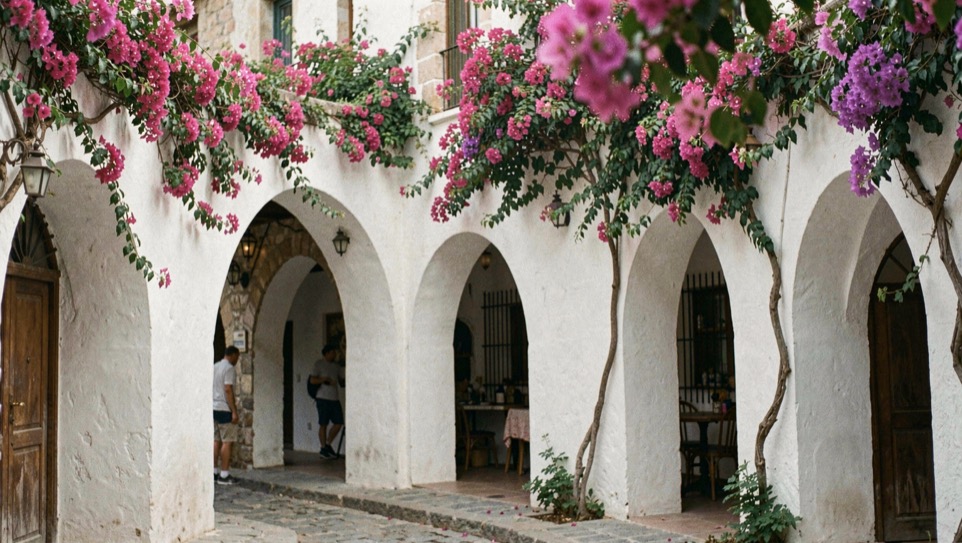
Every town that looks inevitable was once somebody’s argument. The argument for Rancho Santa Fe was made in plaster, wood and clay tile by Lilian Jeannette Rice, the architect hired in the early 1920s to give the Santa Fe Land Improvement Company’s residential colony a form. What she built, above all the village civic center, set a vocabulary that the community has been speaking, with discipline and occasional eloquence, for a century.
An architect of the first rank, on the edge of the map
Rice was born in 1889, graduated from the University of California, and became one of California’s early licensed women architects at a time when the profession barely admitted the possibility. Working from San Diego and then from an office in the village itself, she received the commission that would consume her career: master architect for the subdivision, planner of its civic center, designer of its earliest and most influential residences. She died in 1931, young, leaving a body of work small in number and disproportionate in consequence, since it became the standard a covenant would enforce ever after.
Her instrument was the Spanish Colonial Revival, a style then surging through California after the 1915 Panama California Exposition in San Diego’s Balboa Park made romantic mission architecture the region’s official daydream. The revival’s catalog is familiar: white or tinted plaster walls, low pitched red clay tile roofs, arched openings, courtyards, deeply recessed windows, wrought iron and carved wood. What separated Rice from the revival’s ordinary practitioners was restraint. Where lesser talents piled on arcades and ornament, she edited, producing simple volumetric compositions whose sophistication lived in proportion, shadow and the relation of building to garden.
She drew for a place, not for a portfolio: plaster walls, tile roofs and shade, arranged so the valley could recognize itself.
The village as a whole work
Her civic center remains one of Southern California’s most convincing pieces of town planning, modest in scale and complete in intention: commercial buildings joined by arcades, a courtyard scheme that turns its back on the automobile and its face to the pedestrian, gardens and gathering spaces threaded between, everything built of a piece with the residential streets around it. The guest lodge she designed for the development’s visitors grew in time into the village’s landmark inn, and the district’s presence on the National Register of Historic Places recognizes the coherence of the whole. Walking it is the best short education in her values; our village morning walk follows the arcades where they read best, at opening time.
Her houses taught the Covenant how to live outdoors: courtyards entered before the street door, loggias oriented to the afternoon, windows punched for breeze and view rather than for symmetry’s sake alone. That outdoor indoor grain has proven remarkably durable; it suits the climate exactly, which is why the best contemporary homes in the area, whatever their formal liberties, still obey her spatial instincts.
A legacy enforced by covenant
Architecture this coherent survives only by intention. The Covenant’s art jury, reviewing changes to this day, keeps Rice’s language legible across generations of owners, architects and fashions; the story of that machinery is part of our Covenant essay. The revival she practiced is not the area’s only tradition: the quieter, older Monterey Colonial mode, which we treat in its own essay, mixes Spanish plan and Anglo woodwork, and the region’s ranch houses carried her shade logic into the mid century. But when a community argues, as communities do, about whether a wall or a roofline belongs, the argument is settled against her example. That is a rare kind of longevity for any architect.
Field notes
- Lilian Rice, 1889 to 1931, was the subdivision’s master architect and one of California’s early licensed women architects.
- Her village civic center, with its arcades and courtyards, anchors a National Register historic district.
- The Spanish Colonial Revival she practiced here is distinguished by restraint: proportion, shadow and garden before ornament.
See where her style sits among the region’s traditions in California ranch architecture, and walk the streets that resulted via the Rancho Santa Fe neighborhoods guide.